
1870
Farming Roots in Rural Kansas
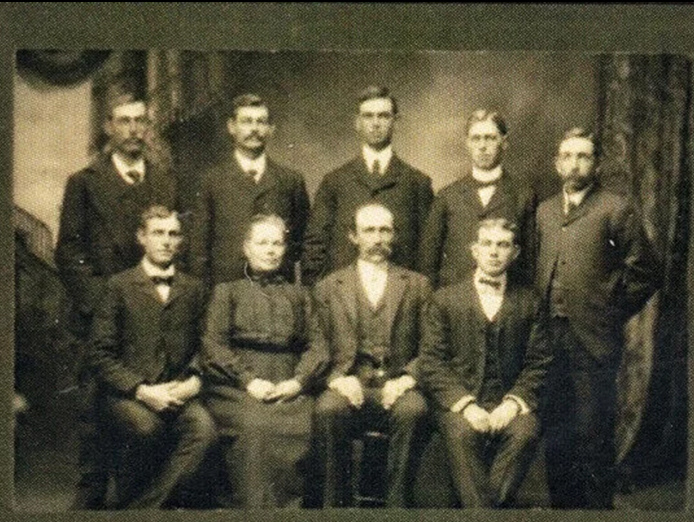
The Applequist Family traces its roots back to Jonas Applequist and his wife, Lena, who left Sweden and came to the United States. For generations the family had worked as farm laborers on large estates. Due to their inability to own land, and their desire to practice their faith freely, they immigrated to the United States in 1868 and settled in Kansas in 1870.
Roy’s Great-Grandfather Jonas acquired a homestead site in a developing Swedish community near Assaria, a few miles south of Salina, Kansas. When the family arrived at Salina’s train station, they did not speak English. They had little money and all of their possessions in one large trunk. They hired a man with a wagon to drive them and their trunk to their new homestead.
It was late October and the family was in dire need of a warm shelter for the winter. While pondering their difficult situation, the family noticed smoke coming up from over a nearby hill. They went on foot to the source of the smoke and discovered a family of Swedes from their hometown in Sweden. These wonderful neighbors offered to shelter both families through the first difficult winter in their two-room dugout.
The following years were filled with ground-breaking hard work.
There was a deposit of sandstone near their property. They traded the stone from some nearby hills for wood from a sawmill, 4 miles away, on the Smoky Hill River near Assaria. This resource-trading made it possible for the family to build a small stone house with a wood roof and a new wooden barn. They also faced the daunting task of breaking sod for the first time so they could plant their crops. This was all done with a horse drawn one-bottom plow.
Quintin, Roy’s Father, was born in 1919, on the family homestead behind the wood stove. He was part of the second generation of Applequist’s to be born and raised on the homestead.
Growing up during the Great Depression wasn’t easy. Through working on the farm and in a machine shop, Quintin developed the abilities and determination that helped him to become a skilled machinist.
During World War II, Quintin lived in Wichita, Kansas, where he helped build prototype tooling for Cessna aircraft. It wasn’t long until he was drafted into the Navy. Due to this machining experience, after bootcamp he was sent to Norman, Oklahoma to receive further training as a machinist. He finished at the top of his class of several hundred sailors which allowed him to stay stateside as a part of the school’s staff for the rest of the war.